
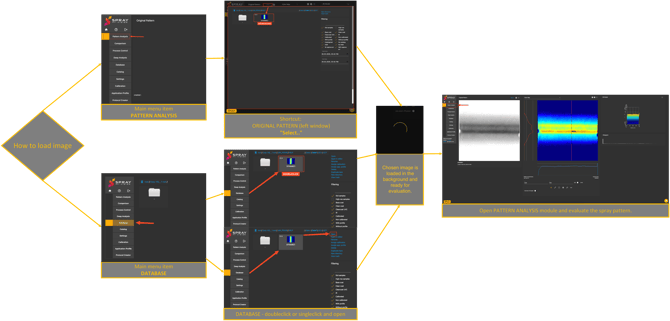
There are two ways to open an image in the Pattern Analysis module. You can either select the image directly in the Pattern Analysis, or select it by double-clicking on the desired image in the Database module and switching to the Pattern Analysis as the next step.
The opening procedure is up to your preference. Below is an infographic of the image opening process:
🔎 Article Overview
Pattern Analysis Module
This module provides tools for quick analysis of captured patterns, such as:
- Measurement of pattern dimensions
- Measurement of pattern volume
- Measurement of dry layer thickness applied to a film in cross-section, point-wise, or within a user-defined area
- Measurement of SB50 and Kapton tape cutouts
- Intensity histogram
- Export of measured thickness data
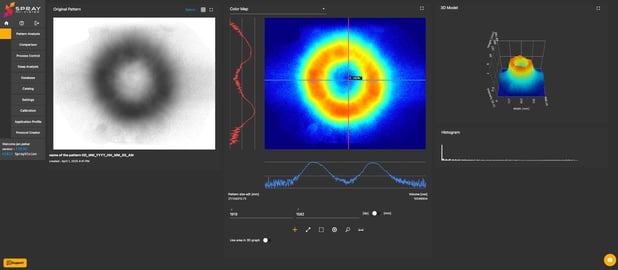
Original Pattern
- Aids in the understanding of the details of the original image.
- The original image is captured in grayscale.
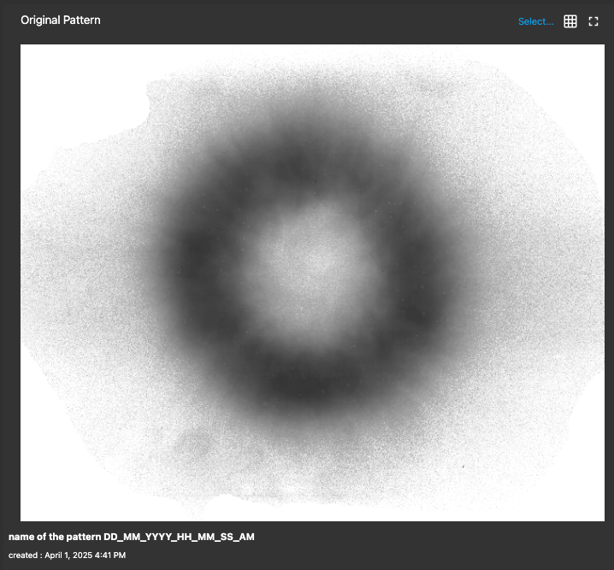
- Displays the image name and timestamp of the captured image.
- Shortcut for Database entry.
- Displays automatic boundary detection of the spray pattern, which serves as an input for calculating the displayed pattern dimensions.
- Fullscreen mode for better inspection of the original image to check for defects.
For a highly detailed analysis of droplets, the Deep Analysis module is recommended.
Color Map
The original image is converted into a color map (for easy recognition of thickness in the pattern layer). Measurements can be taken anywhere on the pattern.
- Fullscreen option for a detailed analysis of the pattern
The color map represents the sensor-detected intensity, expressed in the range 0-1C*:
- When calibration is applied, values are expressed in [μm].
- 0C = maximum intensity, minimal shadowing (dark blue).
- 1C = minimum intensity, maximum shadowing (dark red).
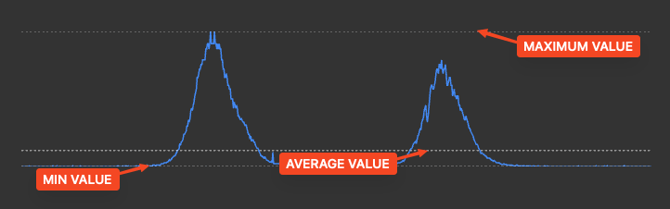
Visualization of measured values along the X and Y axes (red and blue curves):
- The center of the axes can be placed anywhere.
- Individual values can be read by hovering the cursor over the curve.
- You can zoom into parts of the curve by selecting an area (dragging with the left mouse button), or reset the view by repositioning the axis center.
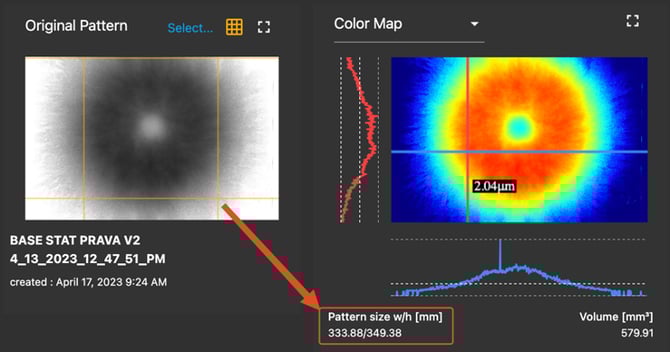
Pattern Size (w/h) [mm]
-
Width and height – automatically detected area.
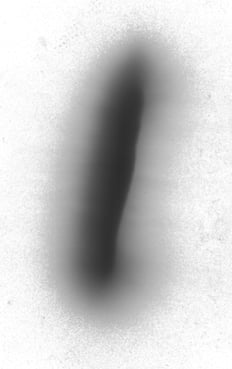
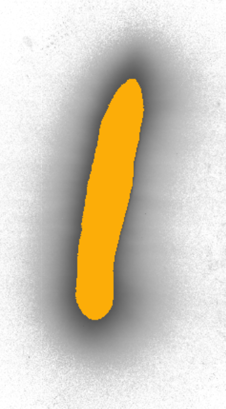
Detection works correctly only if the pattern is clearly visible. Sufficient dark gray presence is required for accurate detection – everything outside the threshold is ignored.
The threshold is hardcoded. The area of the automatically detected pattern can be displayed in the Pattern Editor to improve understanding.
Volume
- Units [vox] are displayed before calibration. "Voxels" are pixels that exceeded the above-defined grayscale threshold. After calibration, units are converted to mm³.
- Units [mm³] are displayed when a calibration is assigned.
Cursor Coordinates at the Center of Axes X, Y Expressed in [dp] or [mm]
- 0,0 is in the bottom-left corner.
- dp = density pixels unit, with 0,0 also in the bottom-left.
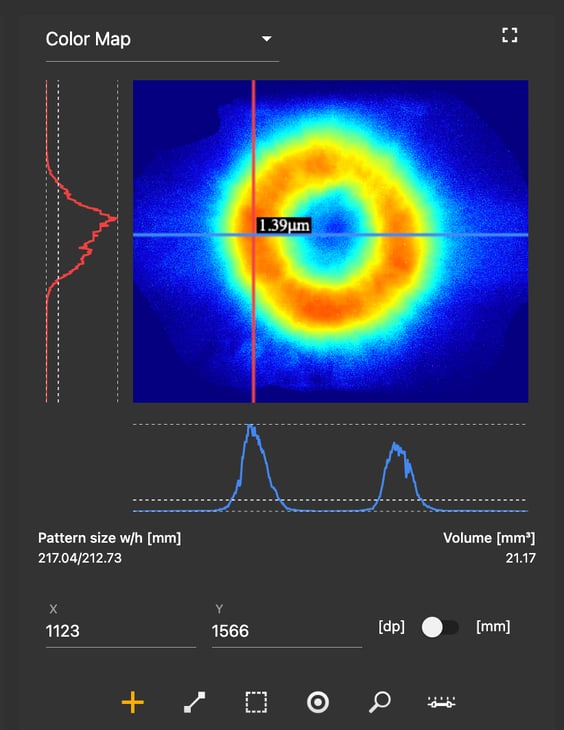
Enable / Disable Cross 
- Click on the image area to anchor the measurement zone. Click again to release the anchor.
- Tool for measuring at a point and along x, y cross-sections (measures captured light intensity/thickness of dry layer applied to film).
 Draw Line
-
Measurement tool for line/segment drawing (left-click and drag).
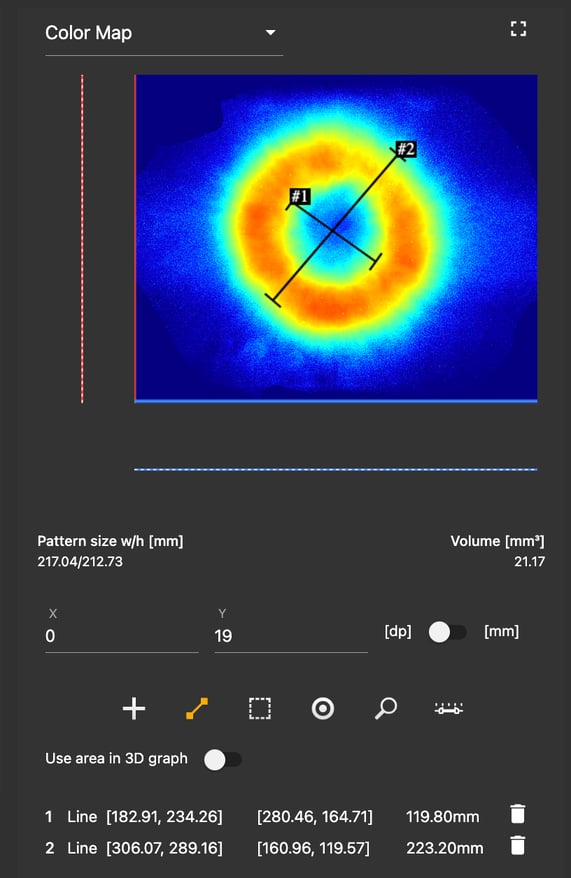
Example:

 Examine Area
- Measurement using rectangle drawing (left-click and drag).
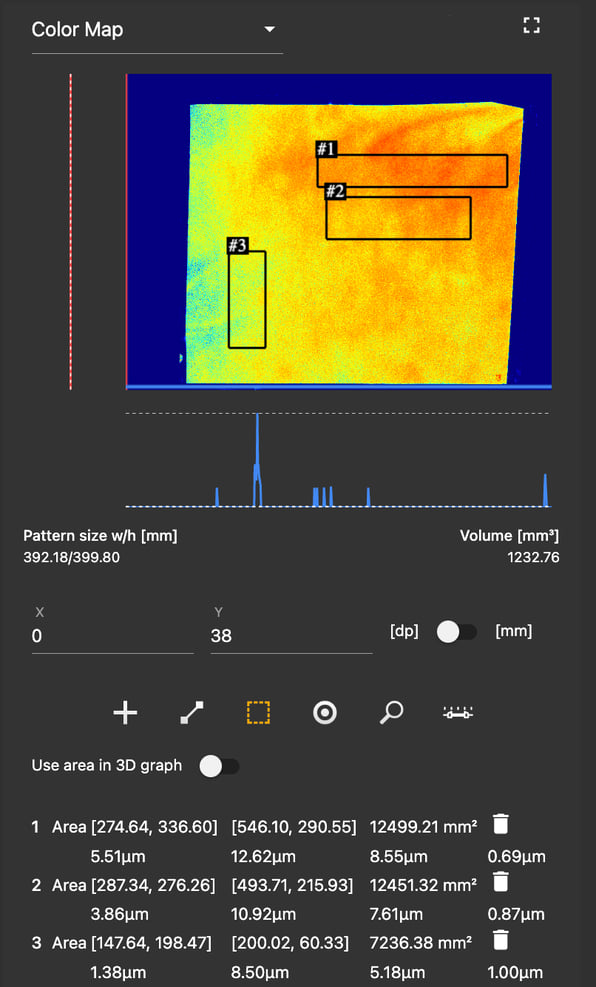
Example:
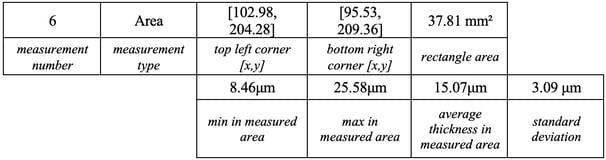
 Examine Diameter
- A specialized tool for measuring the dimensions of bell output.
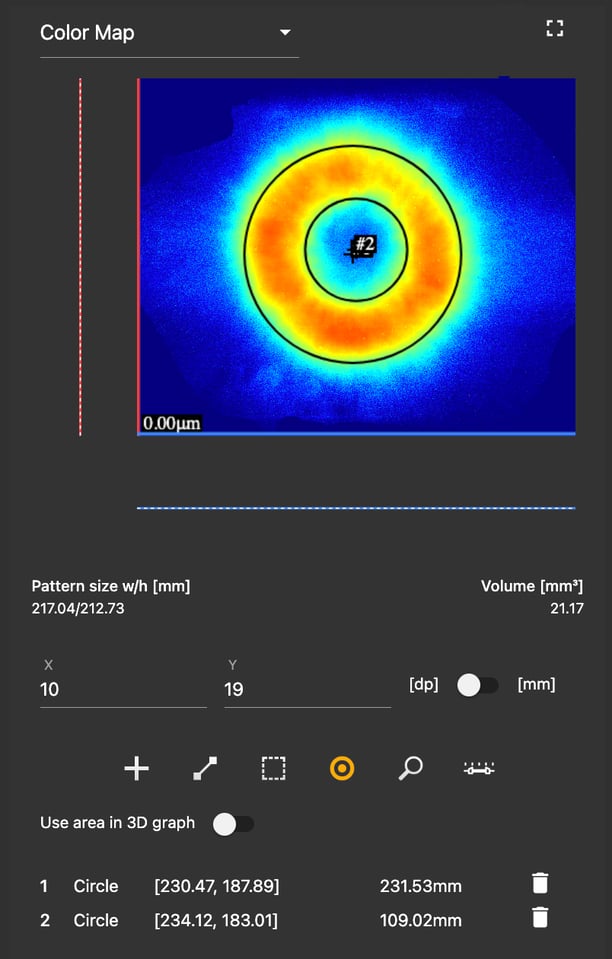
Example:

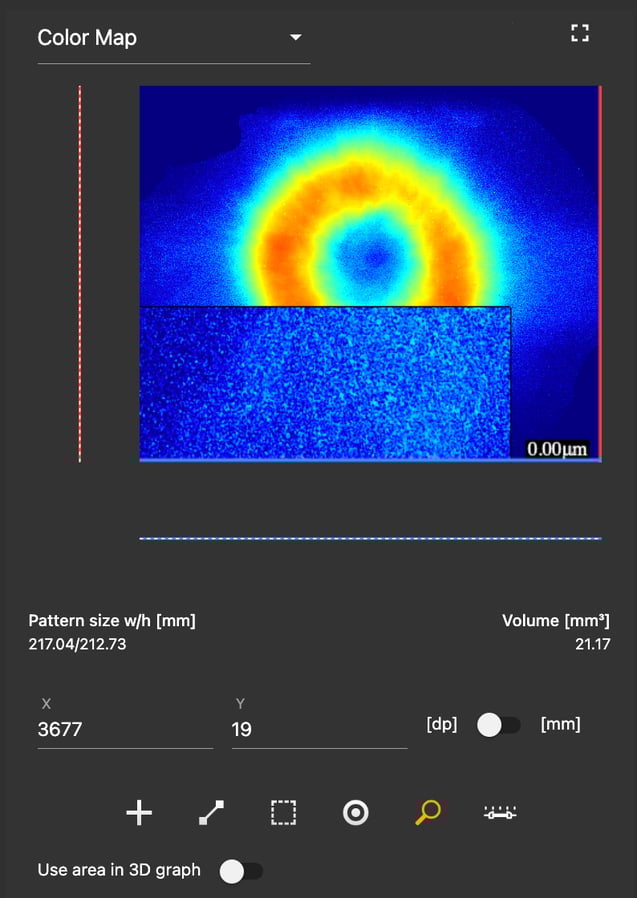
 Zoom
Zoom
-
Clicking on an area of the Color Map generates a zoomed-in window for closer inspection and thickness measurement.
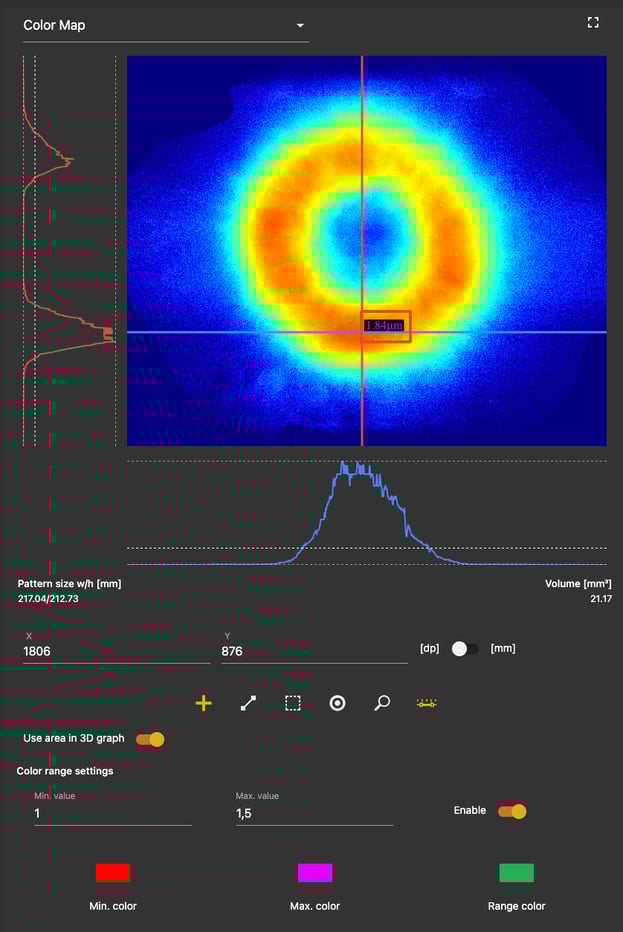
 Color Settings
- Color range settings: Adjusts the range for colorizing thickness values next to the cursor.
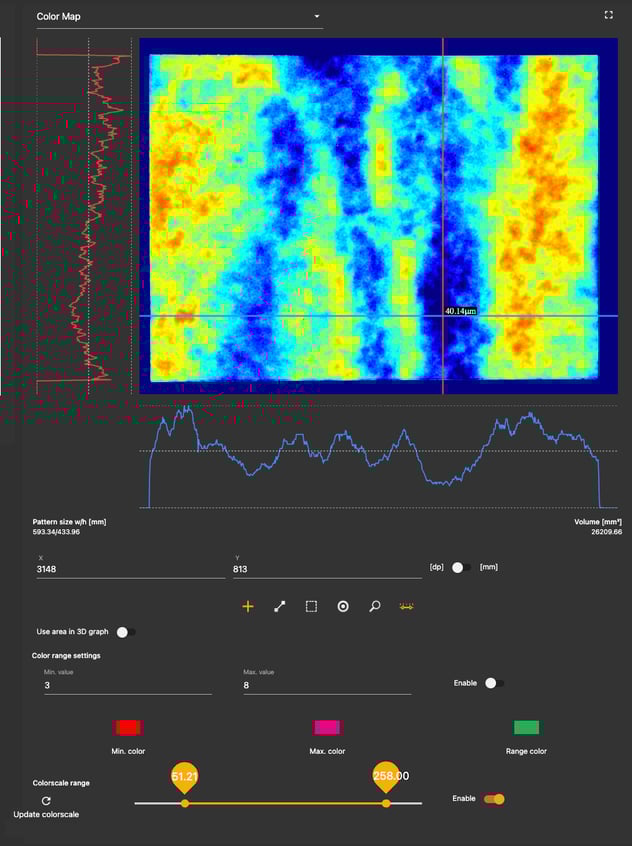
- The color scale adjustment: activate the function using the toggle switch, then adjust the range and click the refresh icon (circular arrow). The color scale will then be recalculated.
 Use Area in 3D Graph
- The selected area (examine area) is displayed in 3D when you activate the toggle "Use area in 3D graph".
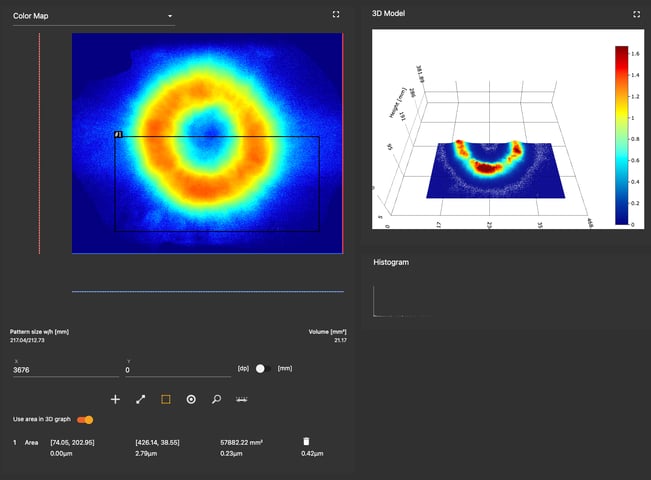
3D Model
A 3D model of the applied layer helps understand better the detailed shape characteristics of an uneven layer.
- The model can be rotated for further analysis.
- The plot can be exported as a .png file. To create reports, use the Protocol Creator module designed specifically for this purpose.
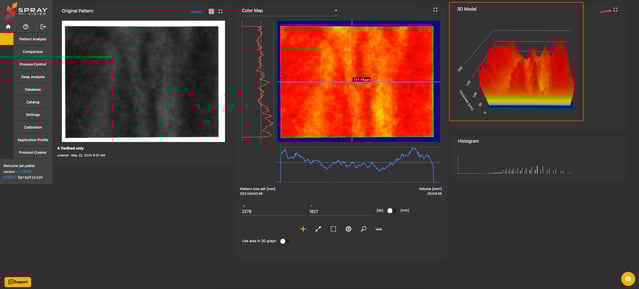
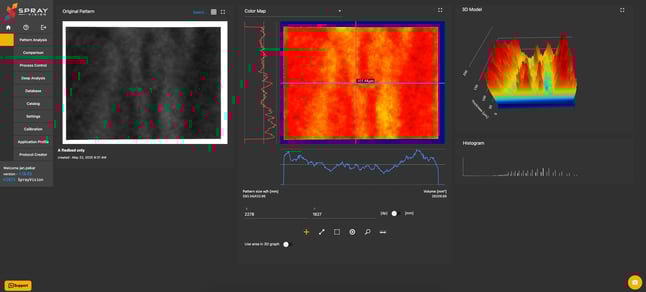
If we need to focus for a specific thickness range of the pattern, we can adjust the appearance of the model. How to do the adjusment:
- Go to the full-screen pop-up window and move the slide bar to the required range.
- You can hide also grid, show the legend-stripe with color range and many more.
Before adjustment:
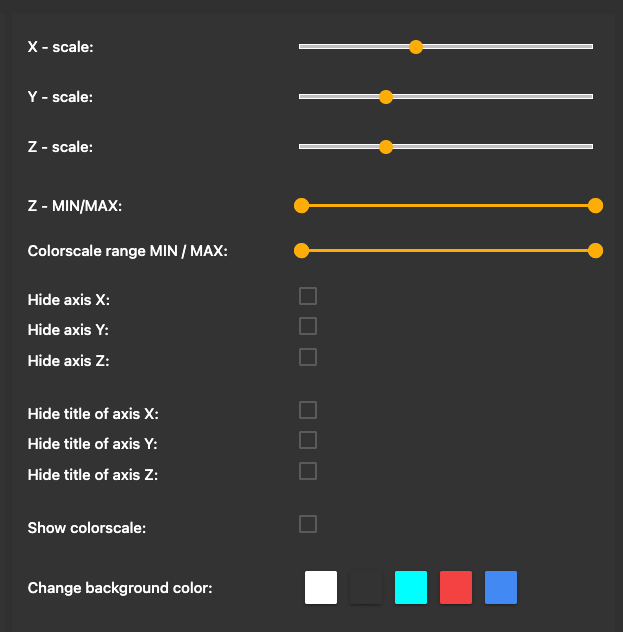
After adjustment:
SB50 Metric
In addition to the Color map, the Pattern Analysis module also enables you to use the SB50 metric to analyze your captured images.
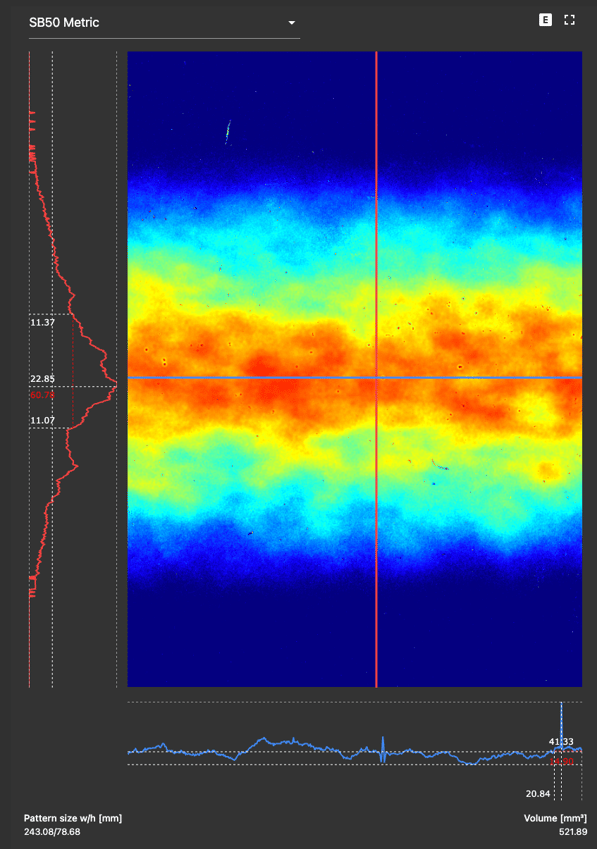
You can utilize multiple tools to measure the effective part of the dynamic pattern:
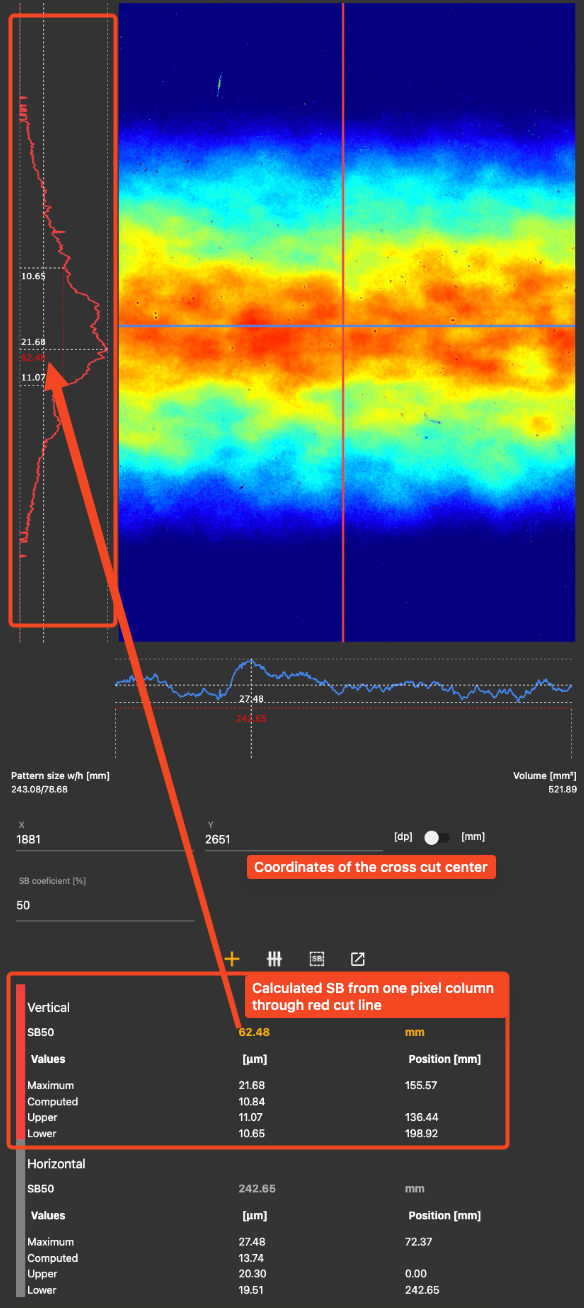
 Cut SB50
Measurement along a cross-section of a single row/column of pixels.
- A useful tool when analyzing the smallest possible part of the pattern.
- Click on the image area to anchor the measurement zone. Click again to release the anchor.
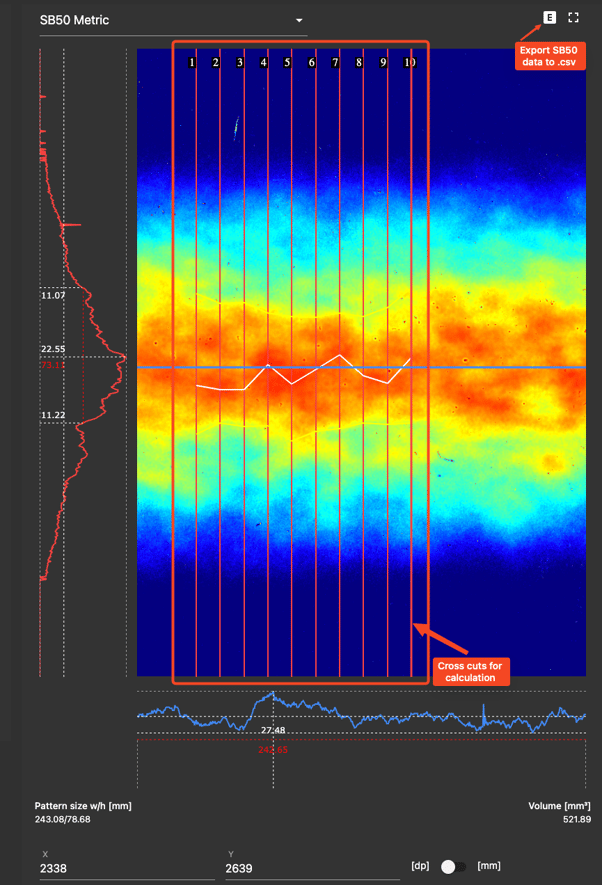
 Multicut SB50
Measurement along a cross-section of 2 to 10 rows/columns of pixels.
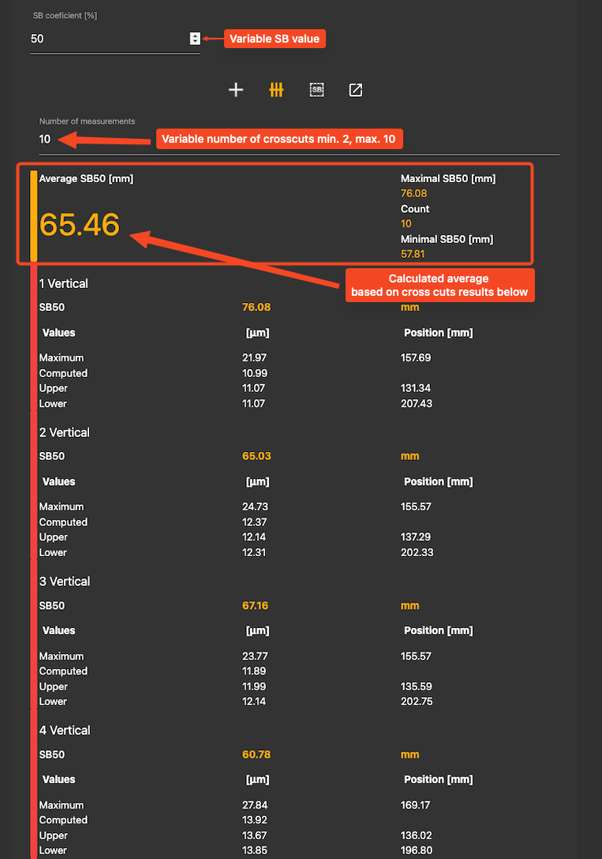
Similar to the CUT SB50 tool. Measurement is performed using click and drag in the desired position and direction. After selecting the measurement area, you can adjust the number of cuts within it.
The function returns individual measurements as well as the final calculation.
- The white line in the area indicates the center point of maximum thickness.
- The yellow outline indicates the 50% points at the edges of the effective area.
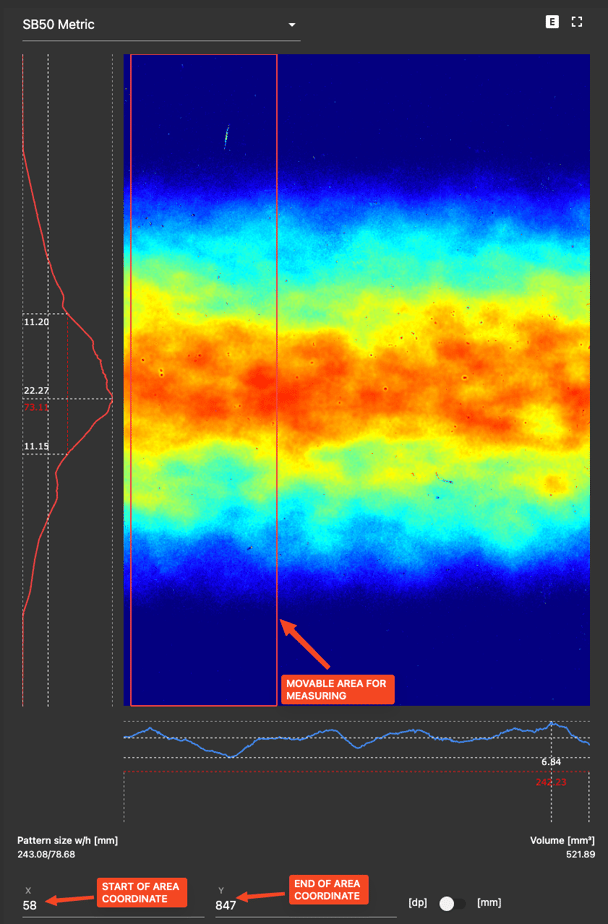
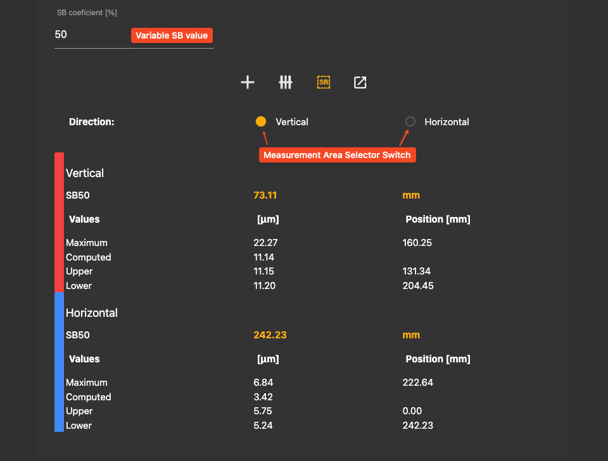
 Area SB50
Average SB50 value measurement within a selected area, calculated per every single pixel row.
The most commonly used tool for measuring SB50, because the SB value is measured in each pixel row within the selected area and then averaged. This ensures a smooth curve without extreme fluctuations caused, for example, by dirt or inconsistency in the selected area.
- Always orient the rectangle so that it is perpendicular to the direction of the dynamic pattern. Then, drag the rectangle across the image to select the most suitable spot for measurement.
- The X coordinate indicates the starting point of the left side of the vertical rectangle.
- The Y coordinate indicates the starting point of the bottom side of the horizontal rectangle.
 SB Overlap
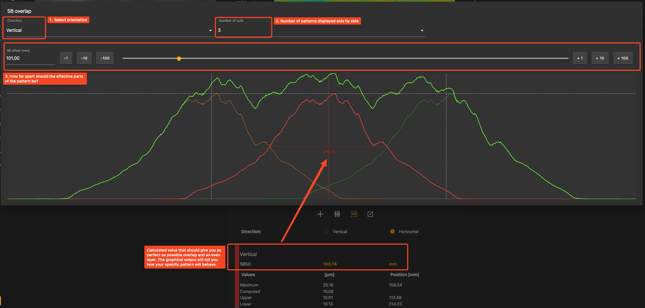
A simulation of overlap with customizable parameters.
- Clicking the icon opens a pop-up window.
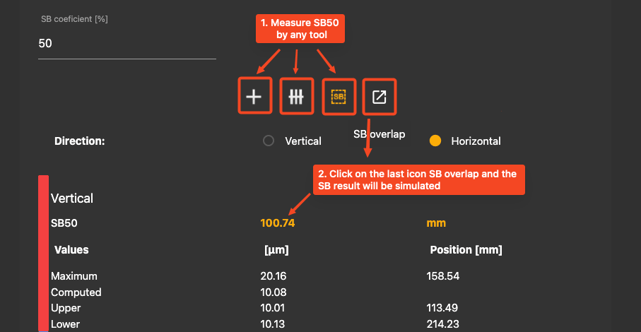
- To simulate SB pattern overlap, perform a measurement using one of the tools. The thickness graph will then be transferred to a popup window, which can simulate overlap based on adjustable parameters.
- Calculated SB value that should give you perfect overlap and an even layer.
The graphical output will tell you how your specific pattern will behave with the SB.
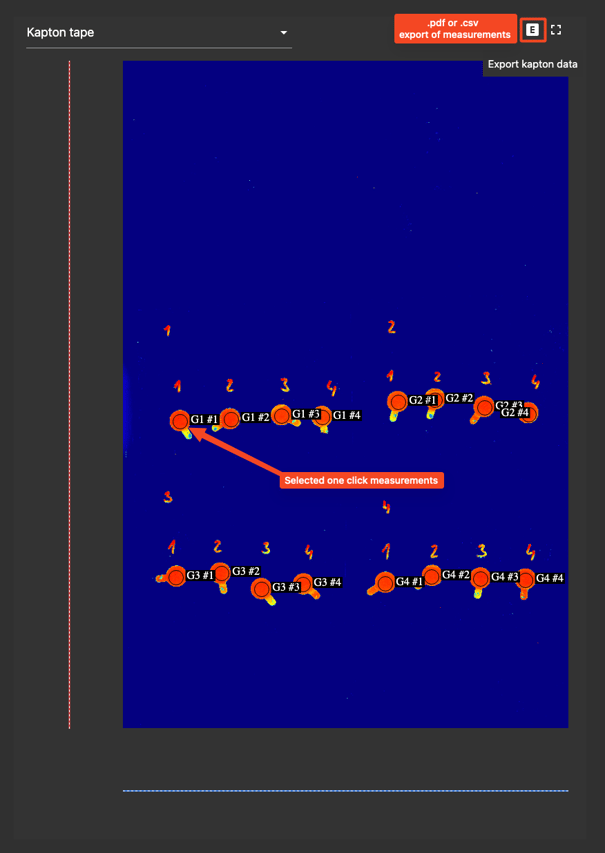
Kapton Tape
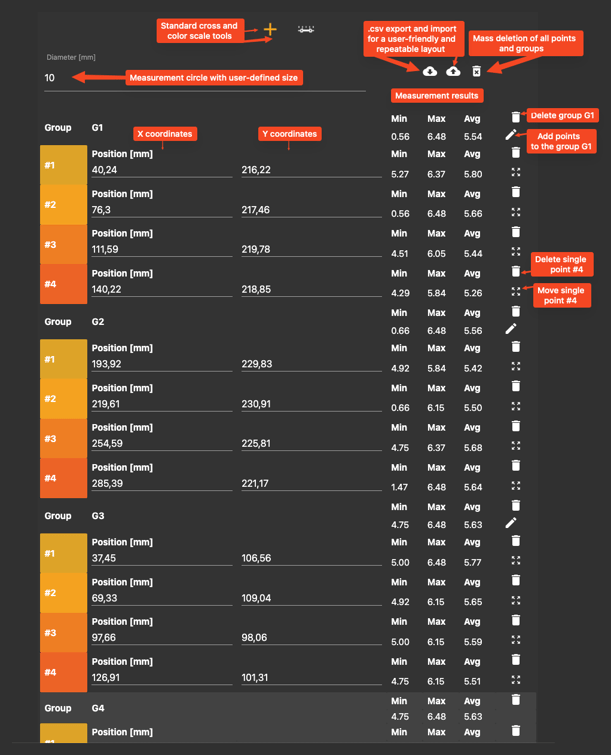
The third option in the Pattern Analysis view is the Kapton tape. This module is designated for quick measurement of Kapton cutouts (or small circular areas on any layer).
- .csv export and import for a user-friendly and repeatable layout (buttons with cloud icons).
- Users can enter custom group names, set precise positions of measurement points, and save the entire layout for later use.
If you require any further clarification, encounter unexpected behavior, or would like assistance with specific parts of the workflow, please do not hesitate to contact our support team at helpdesk@sprayvision.com.
We are ready to assist you and ensure that your experience with SprayVision is as smooth and effective as possible.